
A couple days ago I wrote a post about the orbit of a new dwarf planet candidate. The article says the newly discovered object, ED138, has an orbital period of 281.1 years and is “46 times farther from the sun than Earth is.”
The earlier post showed that we can infer from Kepler’s third law that the orbit must be elliptical, and that therefore the phrase “46 times farther from the sun” is ambiguous. The post worked out the orbit of ED138 under the assumption that the object is 46 AU from the sun at its aphelion, the point in its orbit furthest from the sun.
But what if is “46 times farther from the sun” refers to the average distance from the sun? I added a footnote to the post to explore this possibility. I wanted to expand that footnote into its own post because there’s something I find interesting about it.
If the maximum distance of ED138 from the sun is 46 AU, then the orbit is an ellipse with eccentricity e = 0.067. My intuition was that if we assumed the average distance from ED138 to the sun is 46 AU it wouldn’t make much difference. But it does. In this case the eccentricity becomes e = 0.38, between five and six times larger.
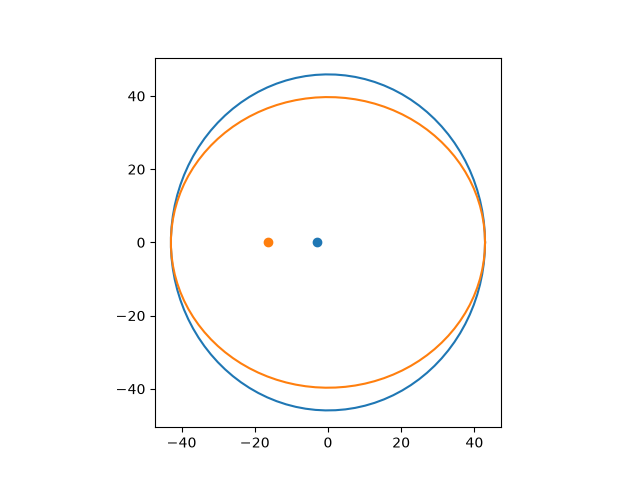
The outer ellipse, plotted in blue, is the orbit assuming 46 AU is the maximum distance. It’s nearly circular. The blue dot is the position of the sun, near the center of the ellipse.
The inner ellipse, plotted in orange, is the orbit assuming 46 AU is the mean distance. It’s noticeably more elliptical. The orange dot is the position of the sun, further away from the center of the ellipse.